How to Build a Budgeting Habit That Actually Sticks
By the My Money Report team ·
Almost everyone has started a budget. Far fewer are still keeping one three months later. The problem is rarely a lack of discipline or the wrong app. The problem is that budgeting is treated as a burst of motivation instead of what it really is: a small daily habit.
The good news is that habits are well understood, and you can engineer one on purpose. Below are the practical principles that turn expense tracking from a chore you abandon into something you barely think about.
Why budgets fail
A budget built on willpower is a budget on borrowed time. Motivation is high in January and gone by February. The people who stick with tracking are not more disciplined than you - they have simply made the habit so small and so automatic that it no longer requires motivation at all.
Three things reliably kill a budgeting habit:
- It is too big. Trying to categorise a whole month in one painful Sunday session guarantees you will dread it.
- It has no trigger. "I will track my spending" is a wish. It never attaches to a specific moment in your day.
- It has no payoff you can see. Effort with no visible reward fades fast.
Make it tiny
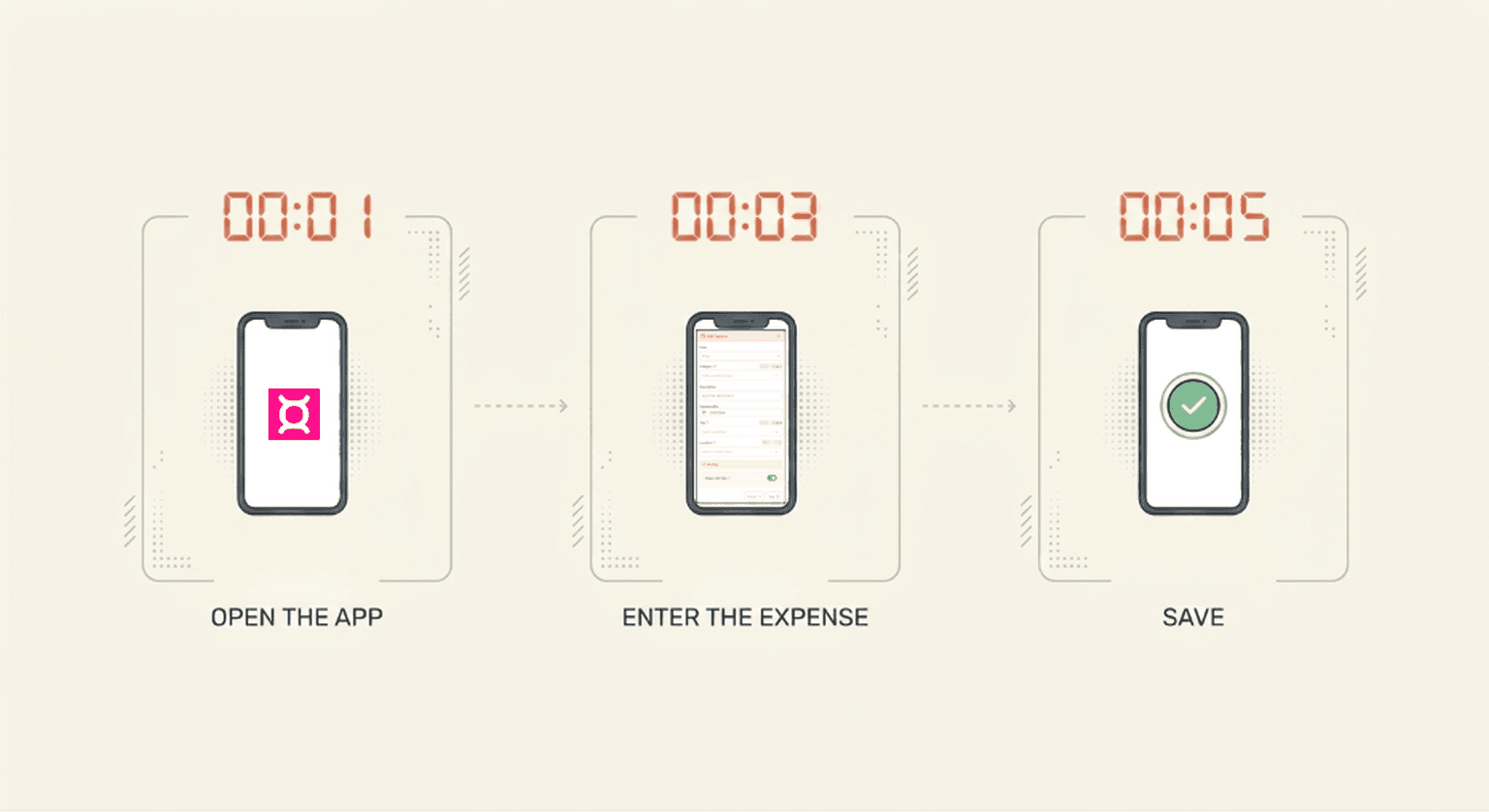
The single most powerful move is to shrink the habit until it feels almost too easy. You are not "doing your budget". You are spending five seconds to record one purchase, right after you make it. Five seconds has no excuse. There is no bad day too busy for five seconds.
When the unit of work is one expense rather than one month, the backlog never builds up, and the dread that comes with the backlog never appears.
Attach it to something you already do
One of the most reliable habit techniques is habit stacking, popularised by James Clear: you anchor a new habit to an existing one. The formula is simple - "after I do X, I will do Y". You can read his short explanation of habit stacking here.
Applied to budgeting, that looks like:
- "After I put my card back in my wallet, I will record the amount."
- "After I sit down on the train home, I will log today's spending."
- "After my evening cup of tea, I will check my plan for tomorrow."
The existing action becomes the reminder. You stop relying on memory, because the trigger is already built into your day.
Plan first, so tracking has a purpose
Recording expenses is far more motivating when they connect to a plan. If you decided in advance that you needed groceries, a birthday gift and a train ticket this week, then logging those purchases becomes a satisfying act of ticking things off rather than a dull data-entry task.
Planning first also creates a gentle checkpoint. When you reach for something you did not plan, you get a useful pause: "I did not plan for this - do I really need it?" That single question, asked at the right moment, saves more money than any spreadsheet.
Make the reward visible
Habits stick when you can see them working. A growing savings number, a chart that turns green when you stay under budget, or a simple streak of days logged all give your brain the small hit of progress it needs to come back tomorrow. Choose a tool that shows you the payoff, not just the paperwork.
How My-Money.Report supports the habit
The whole design of My-Money.Report is built around a three-step habit: plan what you need to buy, write down the price when you buy it, and repeat. It is deliberately small at every step.
Because the app lives on your phone and computer, it is always there for the five-second entry. Your plans double as a shopping list, so tracking feels like ticking off tasks. And your entries turn into clean charts and a rising savings figure, so the reward is right there in front of you. We also keep it free of bank automation on purpose, because the tiny act of typing the amount is exactly the habit worth building.
Start absurdly small this week. Record one purchase, right after you make it, attached to something you already do. Do that for thirty days and you will not be relying on willpower any more - you will simply have a habit.