I Need a Loan. Can I Actually Afford It?
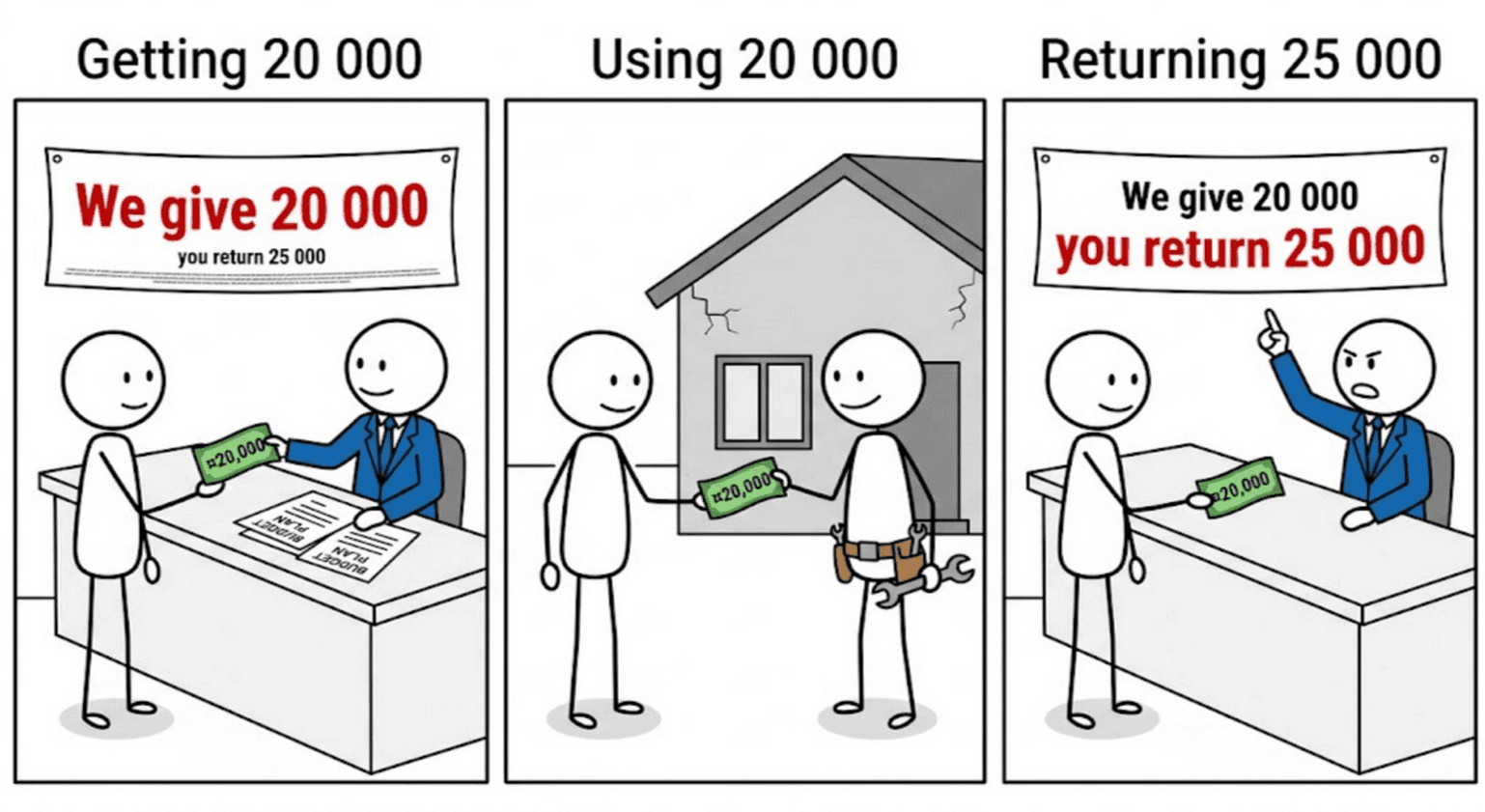
Loans are a very important part of how the economy works. If people stopped borrowing, banks would have to stop paying million-euro bonuses to their management, and nobody wants to live in a world like that.
Joke aside, we all know that sometimes we genuinely need more money than we have. A crisis you did not see coming. A roof that will not survive another winter. A kitchen that is older than your children. A home of your own instead of rent that goes up every year. A loan can be the right answer to all of these.
But there is one fact worth keeping in front of you through the whole process: the full price of a loan is always bigger than the value you get from it. Whatever you borrow, you pay back more, and on a long mortgage the extra can come close to the price of a second, smaller flat. The extra is the price of having the money now instead of later. Sometimes that price is well worth paying. The point of this article is to help you decide when it is, and how much you can really carry, before you sign rather than after.
First, what a loan really costs
Every loan offer is built from four parts, and you need all four to understand it:
- The yearly interest rate. What the bank charges each year for the money you still owe. It is the number in the advert, and on its own it tells you surprisingly little.
- The monthly payment. What leaves your account every month. It covers part of the amount you borrowed plus the interest on what is still outstanding. Early in the loan, a large share of each payment is interest; the amount you owe shrinks slowly at first.
- The total period. How many years you will be paying. This is the part that is easiest to underestimate. A longer period makes the monthly payment smaller, which feels like relief, but you pay interest for more years, so the loan as a whole becomes noticeably more expensive.
- The fees. Arrangement or processing fees, a monthly account fee, valuation and notary costs, mandatory insurance. Each one looks small next to the loan, but added up over the whole period they can matter as much as a difference in the interest rate.
Put together, these give you the only number that shows what the loan really costs: the monthly payment multiplied by the number of months, plus all the fees. That is the total amount payable. Subtract what you borrowed, and what is left is the price of the loan.
Banks usually lead with the monthly payment, because that is the number that makes a loan feel affordable. It answers "can I pay this every month?", which matters. The total answers "is this worth it?", which matters just as much. Always look at both, and when you compare two offers, compare the totals, not the monthly payments or the headline rates.
What to discuss with the loan officer
The loan officer is not your enemy, but they are also not your financial adviser. Their job is to sell a loan that the bank considers safe. Your job is to find out exactly what you are buying. Go in with a list, write the answers down, and ask for everything in writing.
The rate and the risk
- Is the rate fixed or variable? For how long? A "fixed" rate is often fixed only for the first few years.
- If it is variable, what is it tied to, and how often does it change? Then ask the most useful question of the whole meeting: "What would my monthly payment be if the rate went up?" Ask them to calculate it for a realistic rise, not a tiny one. On a long mortgage, even a modest rate increase can raise the monthly payment by a noticeable share. If that new payment would break your budget, the variable rate is a risk you cannot afford, however attractive it looks today.
- What collateral or guarantor is required? Know exactly what you, or someone who signs with you, would lose if things go wrong.
Flexibility and the way out
- Can I repay early, fully or partly, and what does it cost? Paying off a loan faster is one of the best uses of spare money later on. A large early-repayment fee takes that option away.
- If I make an extra payment, does it shorten the term or lower the monthly payment? Shortening the term saves more interest. Some banks let you choose.
- What happens if I miss a payment? Late fees, penalty interest, when it gets reported to the credit registry, and whether payment holidays exist for illness or job loss.
- Can I have the repayment schedule? A table with every payment, split into interest and principal. It makes the cost very concrete, very quickly.
- How long is the offer valid, and do I have a right of withdrawal? For most consumer credit in the EU you can withdraw within 14 days of signing. Even so, never sign on the day of the first meeting. Take the papers home.
Finally, remember that the amount the bank is willing to lend you is the maximum it considers safe for the bank. It is not a recommendation, and it is not a measure of what will be comfortable for you. Plenty of people are approved for a payment that leaves no room for a broken car or a slow month at work.
The decision: give yourself two or three months
Unless it is a true emergency, the best thing you can do before taking a loan is to wait a little and track every income and expense for at least two or three months. Not to delay the decision for the sake of it, but because most of us do not really know what we spend. Ask ten people how much they spend on food per month and most of them will guess low, often by a lot. A monthly loan payment is not a guess. It will arrive on the same day every month for years, and it has to fit into your real spending, not the version you remember.
Why two or three months and not one? Because a single month is rarely typical. One has a birthday, another a car repair, a third an annual insurance bill. Two or three months start to show a pattern, and they catch some of the irregular costs that one month misses.
What to look for
- Your real monthly surplus. Income minus expenses, month by month. Not the average you hope for, the numbers you actually recorded. If the surplus is smaller than the loan payment, no amount of optimism fixes that.
- Your worst month. The loan payment has to be paid in the bad months too. Look at the lowest surplus, not only the average.
- Fixed versus flexible spending. Rent, utilities and existing loan payments are fixed. Eating out, shopping and subscriptions are flexible. The flexible part is where the room for a new payment will have to come from. Seeing it itemised tells you honestly whether you are willing to cut it.
- What the loan changes. A new flat may mean no rent but higher utilities and building fees. A car loan brings insurance, fuel and servicing. Add those to the plan, not just the payment.
Rehearse the payment
This is the single most useful test we know. While you are tracking, pay the future loan to yourself. Every month, on the day the payment would be due, move the full planned amount into a separate savings account and act as if it were gone.
- If you manage it for three months without stress, you have real evidence that you can afford the payment.
- If you keep dipping back into that account by the middle of the month, you have learned the same thing the cheap way, without a contract.
- Either way, the money you set aside is yours. It can become a larger down payment (a smaller loan), or the start of the cushion you should have anyway.
Keep a cushion after the loan
A loan that uses up every euro of your savings for the down payment leaves you one broken boiler away from a second, more expensive loan. Before you sign, make sure you will still have an emergency fund afterwards, ideally a few months of essential expenses including the new payment. Our guide on how to build an emergency fund walks through how big it should be.
You will hear rules of thumb about how much of your income debt payments may take. Treat any such rule as a ceiling, not a target. Your tracked numbers are a much better guide, because they are about you.
Which tool should you use to track?
The honest answer: the one you will actually keep using for three months. Each option has real strengths and real weaknesses.
Paper or phone notes
Good: free, instant, nothing to learn. Writing an amount down by hand makes you feel the spending, which is exactly what you want during a decision like this.
Not so good: nothing adds up on its own. At the end of the month you have a long list and an evening of arithmetic ahead of you. Categories are whatever you remembered to write, comparing months is tedious, and if you share finances with a partner, you now have two notebooks to merge.
A spreadsheet (Excel, Google Sheets, LibreOffice)
Good: complete control. You can build exactly the categories and formulas you want, model different loan amounts and terms side by side, and keep everything for as long as you like. If you enjoy spreadsheets, this is a genuinely powerful option, and it is free or close to it.
Not so good: you have to build it first, and one broken formula can quietly give you the wrong answer. Spreadsheets are awkward to update on a phone at the till, so entries tend to be saved up "for later" and then forgotten. Most home spreadsheets die somewhere in the second month, which is precisely the month you need.
A budgeting app with manual entry (like My-Money.Report)
Good: you record a purchase in a few seconds on your phone, right when it happens, and the totals, categories and month-by-month charts are there without any setup. Surplus per period, the trend over several months and the breakdown of fixed versus flexible spending are exactly the numbers the loan decision needs. You can plan known upcoming costs in advance, and couples can share their records instead of merging two lists. Because entries are typed rather than imported, you also keep the "feel the spending" effect of the notebook.
Not so good: it still depends on your discipline. If you forget to record things, the numbers will be too optimistic, just like a notebook. My-Money.Report deliberately does not connect to your bank, so nothing arrives automatically. And some features are part of a paid plan, while the free plan shows ads. It is worth checking whether the free features are enough for a three-month test before paying for anything.
Automatic bank reports and bank-linked apps
Good: zero effort, and complete for everything that goes through your account. Most banking apps now categorise your spending for free, and the data is already there, so you can look back at the last three months today instead of waiting. It is also useful to see your account the way the loan officer will: they will very likely look at the same statements.
Not so good: the categories are often wrong. A supermarket receipt that included a kettle, a gift and a week of food shows up as one "groceries" line. Cash, a second bank or a partner's account are usually missing, so the picture is incomplete exactly where it matters. Most importantly, you only see the spending after it has happened. Reading a report is easy to skip, and it rarely changes what you do next month. Third-party apps that link several banks also need access to your account data, which is a privacy trade-off worth thinking about.
Our honest recommendation
Use two things together. Pick one tool you record in daily, whether that is a notebook, a spreadsheet or an app, because the daily act of recording is what makes you notice. Then, once a month, compare it with your bank statement to catch anything you missed. The bank statement keeps you complete; the daily record keeps you aware. After two or three months of that, you will know your numbers better than the bank does.
And if, after all that, you decide you can afford the loan, go ahead with a calm mind. If you decide you cannot, do not feel bad for the bank. Somewhere a board of directors will have to make do with a slightly smaller yacht this year, and we are confident they will find the strength to carry on.