Why Manual Expense Tracking Beats Automatic Bank Sync
By the My Money Report team ·
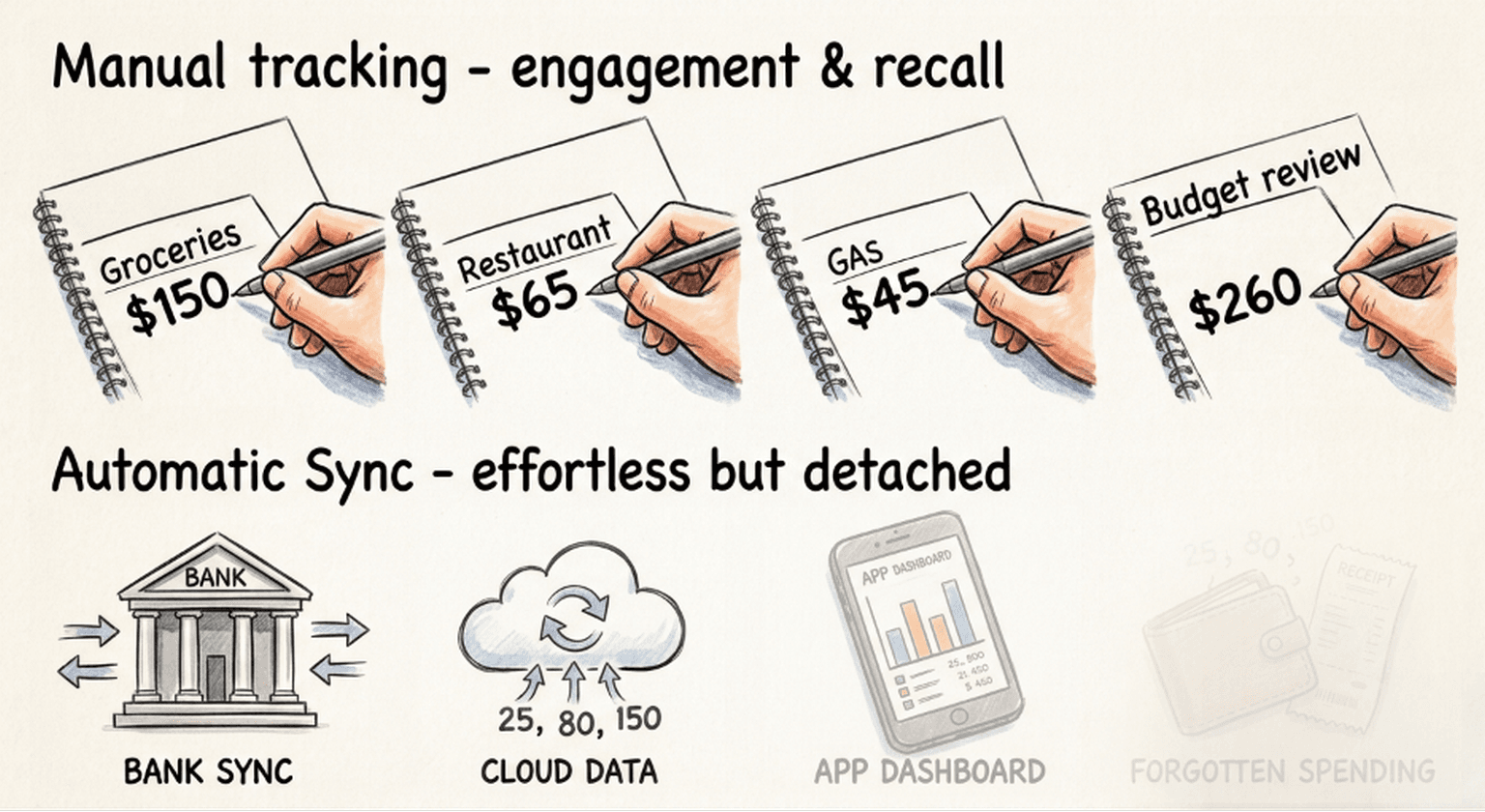
Every budgeting app seems to promise the same thing: connect your bank and never lift a finger again. It sounds wonderful. So why do so many people connect their accounts, watch the transactions pour in, and still have no idea where their money went?
The uncomfortable answer is that the effort was never the problem. In budgeting, the small effort of recording a purchase yourself is not friction to be removed. It is the entire mechanism that changes your behaviour.
The "pain of paying"
Behavioural economists have a name for the healthy little sting you feel when you hand over money: the pain of paying. That sting is useful. It is your brain registering that something of value just left your hands, and it acts as a natural brake on overspending.
The trouble is that modern payment methods are designed to remove that sting. A famous MIT study by Drazen Prelec and Duncan Simester found that people were willing to pay far more for the same item when using a credit card instead of cash - in some auctions up to double. You can read the MIT Sloan summary of that research here. Contactless taps and one-click checkouts push the effect even further. The money disappears before your brain has a chance to object.
Automation removes the wrong friction
Here is the irony. When an app silently imports and categorises every transaction, it removes the one moment that could have made you think. You end up with a beautiful, automatic report about money you already spent without noticing. The dashboard is tidy. Your habits are unchanged.
Automatic tracking is great at answering "what did I spend?" after the fact. It is almost useless at the more important question: "should I spend this at all?" That question can only be asked in the moment of paying, and only if you are paying attention.
What typing it yourself actually does
Recording a purchase by hand rebuilds the pause that cards and taps took away. In the few seconds it takes to enter the amount, three quiet things happen:
- You see the real number, in isolation, instead of buried in a statement.
- You connect it to a category, so patterns become visible over time.
- You get a moment of reflection - a natural checkpoint to ask whether it was worth it.
This is the same insight behind the century-old Japanese method of kakeibo, where writing expenses by hand is considered the very thing that makes the practice work. The medium has changed from paper to phone, but the principle has not: awareness comes from doing it yourself.
"But is it not a lot of work?"
It is far less work than people expect, because you are not reconciling a month at a time. You are recording one purchase, in five seconds, right when it happens. Done that way, manual tracking costs you a couple of minutes a day and hands you something automation never can: a genuine sense of where your money goes and why.
And you keep something else, too - privacy. You never have to hand your banking login to a third-party aggregator, because there is nothing to connect.
The philosophy behind My-Money.Report
This is exactly why My-Money.Report does not link to your bank, and never will. It is a deliberate choice, not a missing feature. The app is built around a simple habit - plan what you need to buy, write down the price when you buy it, and repeat - because the small act of typing the amount is the "trick" that helps your brain feel the true value of your money.
Our job is not to do the noticing for you. It is to make your own noticing as easy and rewarding as possible: plans that double as a shopping list, clean charts that turn your entries into insight, and budgets you can share with your family. You bring the five seconds of attention. The app does the rest.
If effortless bank-sync budgeting had worked for you, you probably would not be reading this. Try the opposite for a month. A little effort, in the right moment, is what finally makes the difference.